Get Familiar with Talented Generation

Showing posts with label Tuesday Trailblazer. Show all posts

Wednesday, February 02, 2011

Tuesday Trailblazers

The Greensboro Four (North Carolina A&T College, 1960)

The sit-in movement used the strategy of nonviolent resistance. As far back as 1942, the Congress of Racial Equality sponsored sit-ins in Chicago, as they did in St. Louis in 1949 and Baltimore in 1952. In August, 1939, African-American attorney Samuel Wilbert Tucker organized a sit-in at the then-segregated Alexandria, Virginia, library. Tucker would continue his efforts of desegregation by inspiring four men to execute one of the most instrumental actions in Civil Rights history. 

Four men: Ezell Blair, David Richmond, Joseph McNeil, and Franklin McCain organized the first “official” sit-in of the Civil Rights Movement. On February 1, 1960, the four students from the Agricultural and Technical College of North Carolina  sat at the lunch counter at Woolworth’s in Greensboro, NC and ordered coffee iFollowing store policy, the lunch counter staff refused to serve the African American men at the "whites only" counter and the store's manager asked them to leave. The men refused to move until the store closed. The next day, they recruited more than 20 students to join them, asking them to dress professionally, sit quietly, and leave every other stool available for any White supporters who might be inspired to join the cause. A statement issued by Woolworth's national headquarters said the company would "abide by local custom" and maintain its segregated policy. On day three, more than 60 students were involved. On the fourth day, 300 people came out and also spread the boycott to the lunch counter at a local Kress store.
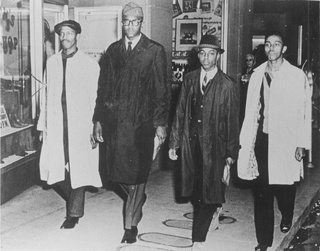
By the second week of February that year, students and activists in other Southern cities, including Raleigh, Richmond and Nashville copied the Greensboro Four’s efforts. By July 1960, all Woolworth’s lunch counters were desegregated. The sit-in helped increased national sentiment and word quickly spread. 

As early as one week after the Greensboro sit-in had begun, students in other North Carolina towns launched their own sit-ins. Demonstrations spread to towns near Greensboro, including Winston-Salem, Durham, Raleigh, and Charlotte. Out-of-state towns like Lexington, Kentucky also saw protests.
The movement then spread to other Southern cities including Richmond, Virginia, and Nashville, Tennessee where the students of the Nashville Student Movement had been trained for a sit-in by civil rights activist James Lawson and had already started the process when Greensboro occurred. Although the majority of these protests were peaceful, there were instances where protests became violent. For example, in Chattanooga, Tennessee, tensions rose between blacks and whites and fights broke out
As the sit-ins continued, tensions grew in Greensboro and students began a far-reaching boycott of stores that had segregated lunch counters. Sales at the boycotted stores dropped by a third, leading the stores' owners to abandon their segregation policies. 
Black employees of Greensboro’s Woolworth’s store were the first to be served at the store's lunch counter, on July 25, 1960. The next day, the entire Woolworth's chain was desegregated, serving blacks and whites alike.
I know we have spotlighted these gentlemen before but there story is worth telling again.
Talented Generation Salutes the "Greensboro Four": Ezell Blair, David Richmond, Joseph McNeil, and Franklin McCain!!!! 


Tuesday, January 18, 2011

Tuesday Trailblazers

Bernard Shaw

Bernard Shaw is an American journalist and former news anchor for CNN from 1980 until his retirement in March 2001. Shaw was born on May 22, 1940, in Chicago, Illinois.  


"Mr. Cronkite, I have to talk to you. I have to be a journalist. And I have to find out how I do that."

In the 1960s as a  21-year-old corporal in the Marines stationed in Hawaii, Shaw took advantage of the opportunity to speak with one of his heroes(who became a long time friend)-Walter Cronkite. Shaw served in the Marines until 1963 when he enrolled at the University of Illinois at Chicago from 1963-1968. Shaw began his broadcasting career as an anchor and reporter for WNUS in Chicago. He then worked as a reporter for the Westinghouse Broadcasting Company in Chicago, moving later to Washington as the White House correspondent. Shaw worked as a correspondent in the Washington Bureau of CBS News from 1971 to 1977. In 1977, Shaw moved to ABC News as Latin American correspondent and bureau chief before becoming the Capitol Hill Senior Correspondent. He left ABC in 1980 to move to CNN as its Principal Anchor.


Shaw is widely known for the question he posed to Democratic U.S. presidential candidate Michael Dukakis at his second Presidential debate with George H. W. Bush during the 1988 election, which Shaw was moderating. Knowing that Dukakis opposed the death penalty, Shaw asked Dukakis "Governor, if Kitty Dukakis were raped and murdered, would you favor an irrevocable death penalty for the killer?" To which the Governor responded, "No, I don't, Bernard. And I think you know that I have opposed the death penalty all of my life..." Click here for the footage.

"Whoa! The skies over Baghdad have been illuminated. This is thunder. This is lightning. This is death. This is hell."
He is perhaps mainly remembered for his reporting on the 1991 Gulf War. Reporting with CNN correspondents John Holliman and Peter Arnett from the Al-Rashid Hotel in Baghdad, he found shelter under a desk as he reported cruise missiles flying past his window. He also made frequent trips back and forth from the hotel's bomb shelter. While describing the situation in Baghdad, he famously stated "Clearly I've never been there, but this feels like we're in the center of hell." Check the video below for part of one of his broadcasts.


He moderated the October 2000 vice-presidential debate between Dick Cheney and Joe Lieberman. Shaw co-anchored CNN's Inside Politics from 1992 until he retired from CNN in 2001. In 2001, CNN aired a farewell tribute to Shaw. You can view the transcript here. He has occasionally appeared on CNN, including in May 2005 when a plane flew into restricted air space in Washington, D.C.


I must acknowledge that the "color" of newscasts has changed since Shaw reported on the Gulf War back in 1991 and I think its a shame. It baffles me that networks *cough cough* can claim to deliver "fair and balanced" news without a diverse staff. Blacks continue to rarely get the big stories, the prime-time slots, or headline their own shows. I understand that you do not have to be diverse to deliver accurate news, but there is something to be said about the importance of having a staff similar to the people you're reporting on.  I digress...

Talented Generation Salutes Bernard Shaw!!!

Tuesday, January 11, 2011

Tuesday Trailblazers!!!


Michel Martin


In our inaugural edition of "Tuesday Trailblazers," I decided to give the spotlight to someone whose excellence in journalism has earned her many loyal fans-Michel Martin. She is the host and developer of Tell Me More, the one-hour daily NPR news and talk show that made its national premiere on April 30, 2007, on public radio stations around the country. A native of Brooklyn, NY, Martin graduated cum laude from Radcliffe College at Harvard University in 1980 and has done graduate work at Wesley Theological Seminary in Washington, D.C. In her show's development stages,  Martin served as contributor and substitute host for NPR newsmagazines and talk shows, including Talk of the Nation and News & Notes.


Before she joined the NPR family, Martin worked for several other news sources including the Washington Post, Wall Street Journal, PBS and ABC. Martin covered state and local politics for the Washington Post and national politics and policy at the Wall Street Journal, where she was White House correspondent. She was a regular panelist on the PBS series Washington Week and a contributor to NOW with Bill Moyers


During her stint at ABC from 1992-2006, she served as correspondent for Nightline from 1996 to 2006, reporting on such subjects as the Congressional budget battles, the U.S. embassy bombings in Africa, racial profiling and the aftermath of Hurricane Katrina. At ABC, she also contributed to numerous programs and specials, including the network's award-winning coverage of September 11, a documentary on the Anita Hill-Clarence Thomas controversy, a critically acclaimed AIDS special and reports for the ongoing series "America in Black and White." Martin reported for the ABC newsmagazine Day One, winning an Emmy for her coverage of the international campaign to ban the use of landmines, and was a regular panelist onThis Week with George Stephanopoulos. She also hosted the 13-episode series Life 360, an innovative program partnership between Oregon Public Broadcasting and Nightline incorporating documentary film, performance and personal narrative; it aired on public television stations across the country.


More when you read the rest...


Sharing IS Caring